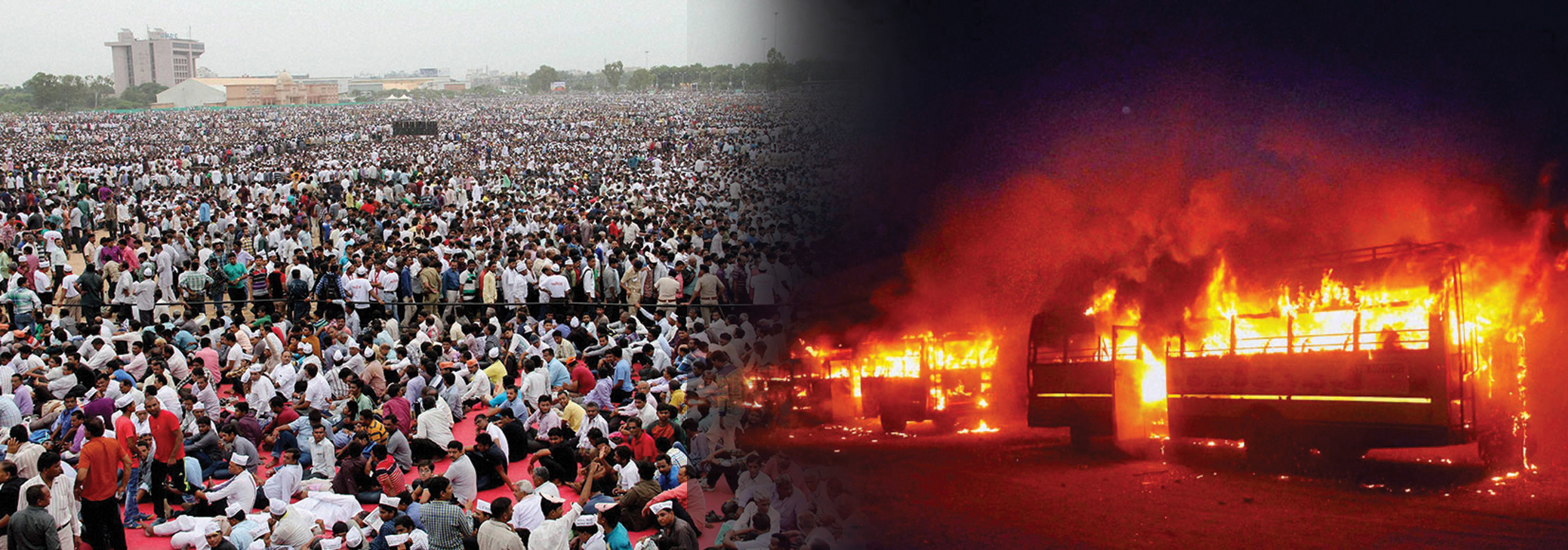
The protest by Patels and other communities in Gujarat have turned violent and as we go to print, at least 8 people have lost their lives. Destruction to the State owned properties run in huge amount. Major cities and towns are under strict surveillance of security forces. These are very sad times for Gujarat and India.
Gujarat Patel youths recently approached the government, petitioning for Other Backward Class status for their community to get reservation in government jobs and education. They knocked doors of every politically influenced leader; appealed with BJP big shots like Amit Shah, trying to influence them to deliver their claims. However, nobody with a hold entertained the community leaders and, their demands never got any support, least an affirmation, from the state government. Not taking rejection well, they took to public demonstrations and fearless rallies promoting their demands. The movement, supported by the Sardar Patel Sevadal, launched the political career of 22 year old Hardik Patel, a virtual nobody who rose and became the face of what is now the biggest protest in the Indian west. He started the Patidar Anamat Andolan Samiti (PAAS), an apolitical organisation. Ruling party BJP sweated, is this the birth of a new profound opposition? They asked.
Several other Patidar communities participated in the protests, all battling internal politics. Demonstrations and agitation started from Mehsana on July 6, and Gujaratis witnessed turf wars between Patidar communities, as Sardar Patel Group leader Lalji was visibly unenthusiastic by Hardik Patel’s nerve. Protests were conducted in Mansa, Visnagar, Vijapur, Lunavada and other parts of the region. The August 17 rally in Surat, particularly caught the media’s eye as an estimate of half million Patels came down to the streets. Latching on to community emotions, Hardik gave fiery speeches saying, “A Patidar student with 90 per cent marks does not get admission in an MBBS course, while SC/ST or OBC students get it with 45 per cent.” He flaunted his ‘56 inch chest,’ saying he will press ahead with their stir till the goal is achieved. Chief Minister Anandiben Patel reasoned it wasn’t possible to give reservations as Supreme Court guidelines bar states from reserving more than 50 per cent seats in government recruitments. Also, if the Patels were included in the OBC list, eligible for 27 per cent quota, the OBCs will revolt for shrunken space. Either ways, the situation was destined to explode in the government’s face.
Despite government’s tactics to settle them down, the Patels, under young Hardik’s leadership, stayed strong and undeterred, planning for a major rally for the 25 of August- the Maha Kranti Rally.
The event was organised at GMDC ground, Ahmedabad for at least 25 lakh people from the community participating. On the morning of the rally, lakhs of people gathered on the grounds for the much hyped Patidar public address by Hardik. Nearly 20,000 security personnel were deployed and roads within a two-kilometre radius of the venue were closed to traffic. He gave a speech in Hindi, directed at BJP. He said if the government ignored the community’s demand, the BJP in Gujarat will face the consequences in the poll and “lotus will not bloom”. Challenging the ruling government, he declined to call off the agitation, asking Anandiben to rethink her decision. He said, “Only if our rights are safeguarded will we let the lotus (the Bharatiya Janata Party's symbol) in 2017. Else, the lotus will never bloom again.”
“Reservation is our right. Give us our right happily or we will snatch it. Whoever will talk of interest of Patels will rule us…If the situation worsens in the state, it will be Gujarat government's responsibility. This is the last rally. After this, we won't do any more rallies but conduct other kinds of programmes. We will announce a future course of agitation.”
However, the entire event took a turn when he suddenly announced calling off the rally and instead sitting on a fast until the CM personally came to accept their memorandum. This change, unwelcome by the Lalji-led SPG, split the community on ideological grounds. The group disowned Hardik’s ‘anshan’ and his demands. Crowds at the ground hungry for a performance protested the cancellation of the rally, only to be consoled by Lalji’s declaration that the show would go on as per schedule. Meanwhile, when Hardik refused to give up his fast after police permission for the gathering expired, he was arrested along with five others from the stage.
The rally that proceeded to the collector’s office passed through a dalit locality, where stone pelting and violence followed, a beginning to an intensely savage evening. Motorcycle-bound and stick-wielding Patidar youths were seen vandalising public and private property and forcing shops and offices to shut. Protestors gathered on several state and national highways across Gujarat and blocked traffic. The stir turned violent after Hardik’s detention and clashes were reported in various parts of the city where police resorted to baton-charge and lobbed teargas shells to control the situation. Police said violent protesters attacked security personnel overnight with stones and sticks and burned government and private vehicles.
Section 144, Curfew was imposed in several places, including Mehsana city, parts of Surat city and Unjha and Visnagar towns, and educational institutions closed in the industrial district. Troopers of the State Reserve Police Force, BSF and Rapid Action Force were deployed in Ahmedabad and Mehsana. Mobile internet services were stopped for a day and the Centre rushed 5,000 paramilitary personnel to Gujarat. Hardik Patel was hastily released by the police as the public aggression mounted. Army conducted flag march on five different routes in Ahmedabad and then in Surat to instil confidence among the people as at least seven persons succumbed to the unravelling violence.
As tension mounted, chief minister Anandiben Patel tweeted saying, “My sincere appeal to the people of Gujarat to maintain peace and not to indulge in activities disrupting law & order across the state.”
Prime Minister Narendra Modi made an appeal for peace in the state. He said, “I request everyone to maintain law and order in the state. Violence should be avoided at any cost as it benefits no one.”
The Patidar community is well rooted abroad and holds distinct recognition in the western countries. Emotionally affected by the ongoing riots in their home state, Non Resident Gujaratis are seemingly appalled by the situation that has uncovered in a series of violence and flames. British-Indian Alpesh Patel said, “Clearly a lot of people feel excluded, dejected, frustrated, aliens in their home State. Positive discrimination in favour of others has caused this. Positive discrimination now for those previously left out, is not the answer, it makes things worse. A genuine meritocracy is what is needed, not reservations, favouritism in order to right old wrongs. It’s not fair on those historically mistreated because of discrimination, but discriminating more in the opposite direction to try and achieve a balance is wrong. Discriminate on merit alone, not on historic injustice.”
The Patel community in India is basically, a farming community. Being dependent on weather, the farming members of the community suffer severe hardship by becoming debt laden and some have resorted to committing suicide. A section of the community considers that the present quota and reservation system results in their hardship. These aspects need special measures and assistance. However, by and large, the community has progressed in all fields and have produced leaders in education, industries, construction, business, politics etc and is considered to be well off.
Complaints abound that some who have been pushed through this system have not been trained sufficiently to catch up and ultimately provide good service when employed. This requires appropriate corrective measures.
Pravin Amin from National Association of Patidar Samaj in the UK said, “Irrespective of these circumstances and facts, I believe that, for now, the downtrodden Dalit and Tribal Communities need to be supported by legislation to enable them to be lifted out of poverty until most of the Indians have risen to a reasonable living standard. I also believe that a fair system, constantly monitored and moderated by adjusting the percentage is essential for India to become a leading nation.”
“Remarks against Mr Narendra Modi and the Chief Minister of Gujarat show how some over confident people become oblivious to the fact that their actions would cause harm to the Prime Minister and ultimately the country. I consider that a peacefully, negotiated solution must be sought.
Alpesh Patel, a well known a media commentator and columnist in the UK said, ““Clearly a lot of people feel excluded, dejected, frustrated, aliens in their home State. Positive discrimination in favour of others has caused this. Positive discrimination now for those previously left out, is not the answer, it makes things worse. A genuine meritocracy is what is needed, not reservations, favouritism in order to right old wrongs. It’s not fair on those historically mistreated because of discrimination, but discriminating more in the opposite direction to try and achieve a balance is wrong. Discriminate on merit alone, not on historic injustice.”
The recent unfold of events takes Gujarat back to 1985, when anti-reservation led to communal riots; dividing the society on castes and communal lines. In 1985, the anti-reservation movement intensified when the then Madhavsinh Solanki-led Congress government proposed to increase OBC quota from 10 per cent to 28 per cent. Incidents of violence continued and many Dalit community establishments were targeted across the state.