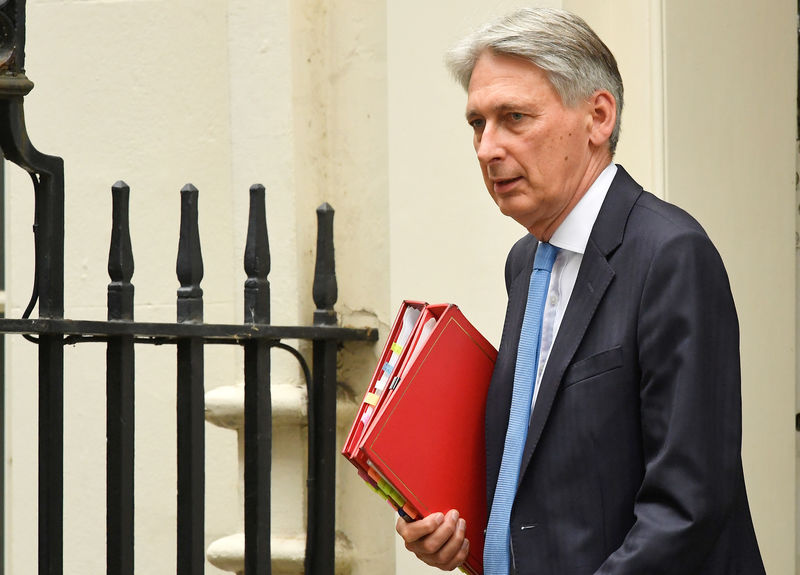
In disappointing news for Chancellor Philip Hammond, the UK government deficit widened unexpectedly in August. According to the Office for National Statistics, public sector net borrowing last month, excluding nationalised banks, grew by £2.4 billion to £6.8 billion compared with August last year. The update comes against a backdrop of steady improvements in recent months helped by relative economic stability, which has driven down the deficit over the course of the 2018-19 financial year to the lowest level for 16 years.
Economists expected the deficit, which is the gap between government spending and tax receipts, to improve about £1 billion. The figures showed slower-than-forecast growth in tax income of 1.6 per cent compared with a year ago, exacerbated by an increase in spending across government departments of 5.4 per cent. Borrowing in the current financial year-to-date now stands at £17.8 billion, almost a third lower than the same period a year ago, and on-track to undershoot the target of £37 billion for the fiscal year set by the Office for Budget Responsibility, the government tax, and spending watchdog.
Despite improving picture over the course of the year, latest figures will upset Hammond, as he prepares for the autumn budget while considering ways to pay for the £20 billion annual increase in NHS spending due by 2023-24, which was promised by Theresa May earlier this year. Economists are slightly more optimistic as they believe the chancellor still has wiggle room because he also set a more short-term target of reducing the deficit to below 2 per cent of national income by 2021, a metric the OBR forecasts he will be able to achieve this financial year.
EU rejects Hammond’s proposal
meanwhile, the European Union has rejected the Chancellor’s bid to include an unprecedented section on financial services in the post-Brexit trade deal, warning that “life will be different” for banks once Britain leaves. Hammond told an audience that “sceptics” of including financial services in a free trade deal were wrong and that such an approach was not only “possible” but “in our mutual interest.”
But Donald Tusk, the president of the European Council, directly rebuffed Hammond’s call, hinting that the UK’s impending departure from the single market, customs union, and jurisdiction of the European Court of Justice made such an approach difficult. “Yesterday the UK Chancellor made a speech in the City of London arguing for a bespoke deal or an ambitious FTA covering financial services – so I will refer to this issue of such great interest to London,” he said.
“In the free trade agreement we can offer trade in goods, with the aim of covering all sectors, subject to zero tariffs and no quantitative restrictions. But services are not about tariffs. Services are about common rules, common supervision and common enforcement. To ensure a level playing field, to ensure the integrity of the single market, and to ensure financial stability, this is why we cannot offer the same in services as we can in goods. It’s also why FTAs don’t have detailed rules for financial services. We should all be clear that also when it comes to financial services, life will be different after Brexit.”
Tusk also rejected the Chancellor’s claim that it would be in the EU’s “mutual interest” with Britain to do a deal on such services. “I fully respect the Chancellor’s competence in defining what is in the UK’s interest but he must allow us to define what is in the EU’s interest,” he said. UK financial institutions can currently do business on the continent without setting up a subsidiary by way of EU “passporting rights” that give them access to EU markets. The EU has said those rights will end after Brexit, while EU officials have rebuffed City financiers who have proposed workarounds.