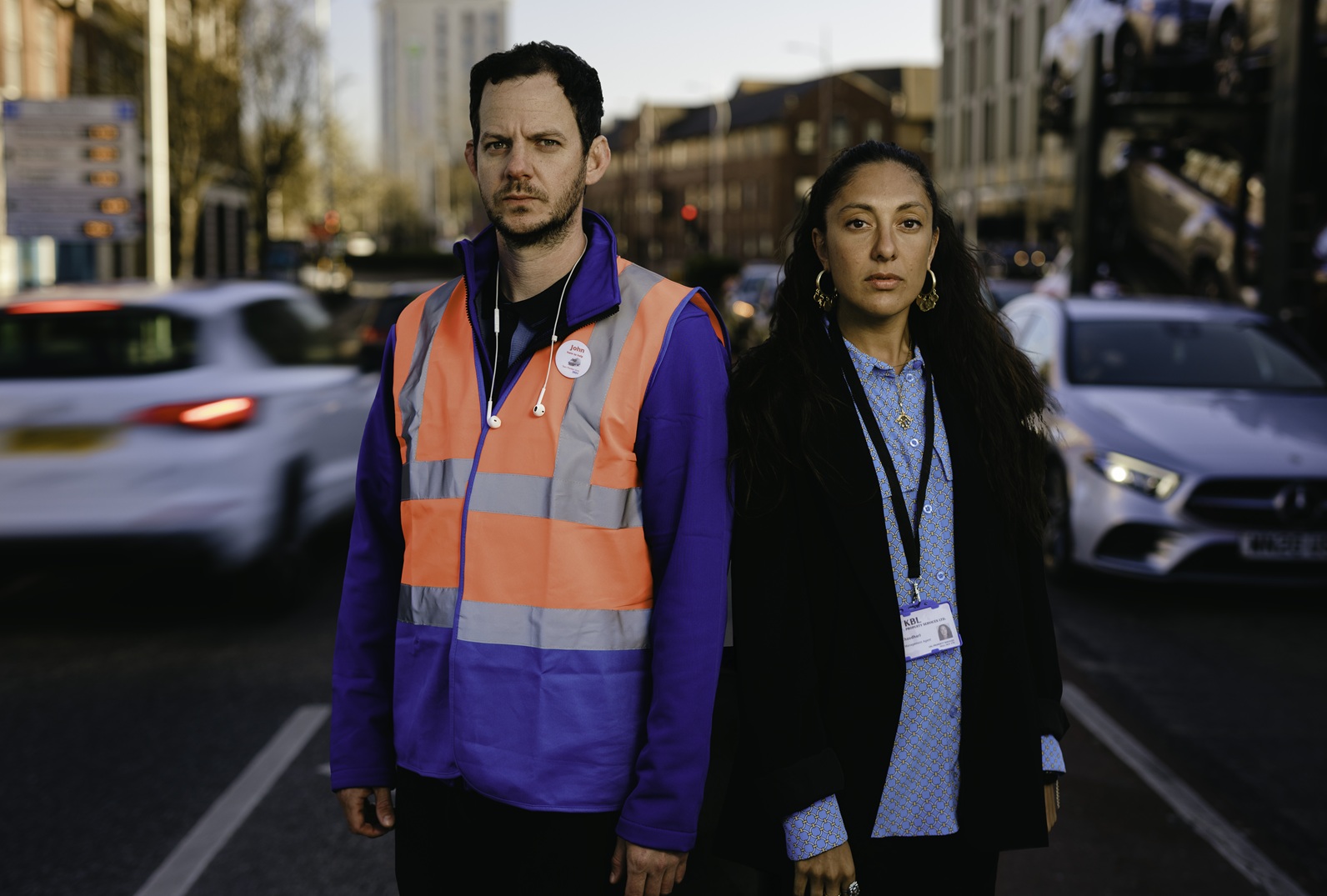
In a time when the world seems increasingly polarised, theatre company Middle Child is bringing a bold and timely production to audiences across the North of England. ‘Biting Point’ explores race, anger, and the unpredictable ways ordinary lives can collide.
Set against the backdrop of a fateful road accident between two strangers — John, a white British delivery driver, and Anita, a British South Asian property manager — the play examines the heat-of-the-moment reactions that reveal deep personal and social tensions. The production is staged with an innovative twist: audiences gather in car parks, seated around the set of the crash scene, with headphones tuning them into the unfolding drama.
Ahead of the play’s North England tour from 10 May to 22 June, Asian Voice spoke to Sid Sagar, the writer of this unique production, about the inspiration behind Biting Point, the complexities of writing about race and anger, and why car parks might just be the perfect setting for conversations we often avoid.
What inspired you to write this particular story? Can you tell us about its development journey since 2023?
The play started as a monologue during the pandemic, inspired by a feeling of powerlessness that many experienced in the face of profound global change. That led to the first draft of a full length play, initially developed through a writers’ group at the Hampstead Theatre in London, and ultimately culminated in a commission with Middle Child in Hull. Paul Smith (Artistic Director) and Matthew May (Literary Manager) encouraged me to find a way to tell a story about rage and race that felt rooted in the North East but might still speak to audiences beyond.
Why did you choose a road accident as the focal point for Biting Point? What does it symbolise in the larger context of the play?
I’ve worked as a delivery driver and was fascinated by the way this role lends itself to stories and people: the constant movement from place to place, the endless interactions with strangers. That’s fairly rare in the modern world. What is unfortunately more common is the anger and aggression that one witnesses on British roads. So a random collision that brings people — who might ordinarily never cross paths — together, felt like an exciting opportunity to tackle broader social issues.
The collision between John and Anita explores more than just road rage. What were you hoping to highlight through their encounter?
John’s a white man from Hull who works as a delivery driver for a supermarket. Anita’s an Asian woman from Grimsby who works as a property manager. In the lead up to their collision, we learn about the things that are weighing them down: there’s family illness, job stress, a horrible hangover, a difficult ex-partner, a young daughter who needs love and care. Their encounter releases something buried deep within John and it turns both their worlds upside down. I wonder if audiences can find compassion in amongst the darkness. I want audiences to sit up, to lean in, to feel Anita’s pain, to understand John’s past, to engage with uncomfortable questions.
What was behind the decision to stage Biting Point in the every day, open-air spaces of car parks?
We’ve been fortunate to receive support and funding from various places, including Without Walls. This intervention in particular forced me to think about how the play might make the biggest impact as both a piece of art, and as a means of connecting with people who might not feel like theatre is for them. Sometimes, this can happen in the most unusual of spaces. Middle Child excels in telling stories in unexpected places and Biting Point will, hopefully, continue to build on this tradition.
Site-specific theatre like this often breaks down barriers between performer and audience. What kind of connection or experience are you hoping audiences will walk away with that they might not get from a theatre seat?
The audience will be in the thick of the action. They will be witnesses, observers, participants, bystanders. They will be confronted with challenging questions. Their connection with the performers will be immediate and active, in a way that is simply not possible in more traditional spaces in which the action takes place behind the “fourth wall”. As both a writer and a regular theatre-goer, I think this kind of involvement is hugely exciting.
You’ve just been cast in Mrs Warren’s Profession at the Garrick. How are you balancing your work as a performer and a playwright right now?
Juggling these commitments can be tricky, but they can also be inspiring: my work as an actor informs the work I want to write, and vice versa. Mrs Warren’s Profession was written by George Bernard Shaw in the late nineteenth century. It’s entertaining and provocative, asking insightful questions about capitalism and about women’s place in an exploitative world order. And in this production in London’s West End in 2025, the play stars Imelda Staunton alongside her real-life daughter Bessie Carter, with direction by Dominic Cooke, former Artistic Director of the Royal Court. Biting Point, meanwhile, is a new play about road rage, race and class, premiering in the North East in the shadow of the 2024 riots. Both projects offer me (and audiences) something different. But they are an important reminder that while creative work can be fulfilling and varied, it also comes with social responsibility: to connect with as diverse an audience as possible and speak truth to power.