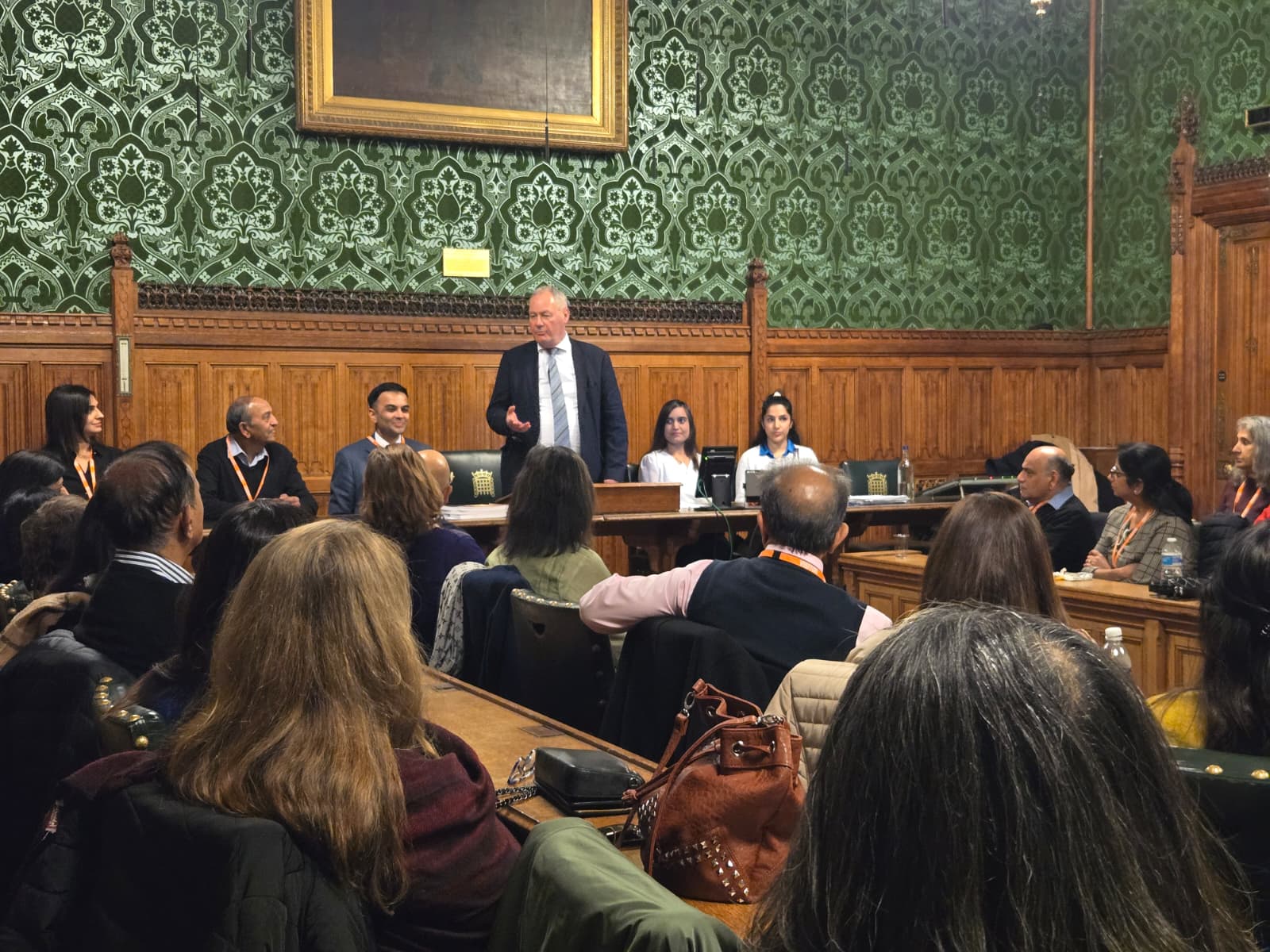
Dhruv Chhatralia BEM created history on 18 November 2025 with the first-ever recital of the ‘Shiva Maha Purana’ at the UK Parliament.
The landmark evening was hosted by Padma Shri Bob Blackman MP inside a packed House of Commons chamber.
The event featured two hours of talks exploring the symbolism of Maa Parvati and Mahadev Shiva, marking a decade of Bob Blackman’s support for Hindu scriptural discourse at the UK Parliament, led by Dhruv.
The evening commenced with resonant Vedic mantras, invoking the blessings of Shiva and Parvati. The gathering brought together community leaders from eight different faiths, dignitaries, media representatives, and delegates from 30+ national Indian organisations. Over 100 guests attended in person, with more than 900 people on the waiting list, reflecting the remarkable enthusiasm surrounding this milestone occasion.
Anusha Sareen delivered an inspiring discourse on how Shiva embodies the Vedas and is revered through the Rudram, symbolising the Vedic Yajna. She described Shiva as Mahakala, the supreme ruler of time and eternal consciousness, and explained that MahaShivratri connects us to our timeless essence. Sareen noted that Yoga reflects the inner journey from the fleeting Jiva to the eternal Shiva, the presence beyond all existence.
Devotion, discernment, and the path beyond ego
Dhruv Chhatralia BEM recited the Shiva Maha Purana, sharing the deeper meaning of its stories. He explained that Yagna stems from “Yaj”, meaning ‘devapuja’ (worship of the Divine to imbibe noble qualities), ‘sangatikaranam’ (bringing together people of shared purpose), and ‘danam’ (donation that amplifies a Yagna’s fruits). Dhruv highlighted the philosophy of “not mine”, central to Yagna. He then narrated the Daksha Yagna as a lesson in overcoming anger for greater longevity and success, he then prescribed a nine step process of remedies to help one overcome their anger according to the Hindu scriptures..
He delivered a powerful talk on the spiritual symbolism of the Daksha Yagna from the Shiva Mahapurana. Dhruv explained that Daksha represents ego-driven action (‘sakamya karma’), performed for self, not the Divine. Sati, his daughter, symbolises the limited intellect that comprehends the world but cannot realise the Self because it originates from the ego. Daksha expects Sati’s obedience, mirroring how ego seeks to dominate the intellect. On the spiritual path, the intellect eventually turns away from ego and seeks Shiva. the Absolute, creating inner friction.
Dhruv Chhatralia BEM said that when intellect confronts ego, it is guided by Shiva’s attendants, the powers of dispassion and discernment. With their help, the illusions that form Daksha’s Yagna hall begin to break and ego-driven values collapse. Among these attendants, Virabhadra embodies ‘paravairagya’, supreme non-attachment, completing the inner destruction of ego and leading consciousness to the highest ‘samadhi’. The story of Shiva reviving Daksha with a goat’s head symbolises the bleating, humbled ego. Ego’s constant assertions are an affront to Shiva, who ultimately strikes it down with His trident. When ego surrenders in humility, it transforms, and Shiva, pleased by this surrender, blesses it with grace.
Dhruv told the audience that at the time of her death, Sati prayed that in her next embodiment she would have ever-increasing love towards Shiva’s feet. Because of that last wish, she was reborn as the daughter of King Himavant, the spirit presiding over the Himalayan mountains, and she was called Uma or Parvati. In the process of attaining Self-realisation, the relative intellect must allow itself to be burned up by the fire of knowledge, the fire of samadhi, so that it becomes transformed. It is no longer the daughter of a vain personality like Daksha, no longer the daughter of the ego. It has been transformed into Uma, the daughter of the Himalayas.
Dhruv Chhatralia BEM said that the Himalayas symbolise the summit of mental evolution, an utterly purified mind whose thoughts naturally seek Brahman. Such intuitive intellect is destined for union with the Divine, guided by unwavering love. This inner ascent unfolds through deep meditation, samadhi, and vichara (spiritual inquiry). Like Uma’s symbolic, unending fasting, a devotee’s austerity is timeless, sustained by the pull of Divine love, without impatience, nourished instead by growing joy each day.
He further explained that as this austerity matures, vairagya (non-attachment) rises, material allure fades, everything becomes insignificant, until even the mind (chitta) is transcended. In the highest samadhi, the Yogi breaks identification with thought itself, flowering into para-vairagya, supreme non-attachment, in which even a leaf or blade of grass, and finally the universe itself, is renounced.
Union, liberation, and the teachings of Shiva
Dhruv Chhatralia BEM said that the seven sages or Sapta Rishis who come to test Uma symbolise the forces governing the five senses, mind, and intellect, principles every seeker must transcend to enter mystic unity. Their questions highlight the divide between worldly reasoning and intuitive wisdom. He then recalled Kama’s attempt to awaken Shiva from ‘samadhi’, noting that Shiva unites with Uma only after Kama is burned, signifying that this is a state beyond passion. Enlightenment, he said, requires devotion to ‘Bhagavan’, creating an inner momentum that frees the mind from worldly pull and dissolves desire at its root.
Dhruv Chhatralia BEM offered a joyous narration of Parvati and Shiva’s wedding, explaining that the ceremony reflects the inner celebration born when intellect turns intuitive and the ‘Jivatma’ realises its oneness with the ‘Paramatma’. The transformed city where Uma awaited Shiva symbolises the ‘chitta’ in its purest form, so radiant that its splendor surpasses even the majesty of Brahma’s creation. He noted that this sacred marriage represents ‘Yoga’ itself, the ultimate union of Shiva and Shakti, the ascent of ‘kundalini’ to unite with the Divine, and the merging of ‘Prakriti’ with ‘Purusha’. It is the soul’s greatest festival, for in this union, the seeker is freed from worldly bondage and awakened into liberation.
Dhruv Chhatralia BEM explained that after the divine marriage, Shiva and Uma abide in ‘Kailasha’, where spiritual bliss rises endlessly. Their union gives birth to ‘Kartikeya’, the Divine army’s fearless general, whose victory over ‘Taraka’ marks the permanent end of ignorance and the restoration of peace. He emphasised that supreme realisation demands one-pointed devotion, nothing worthy is attained with scattered focus. Like Princess Uma surrendering worldly comforts to reach Shiva, a seeker must direct all inner energy toward the Divine. Maa Parvati, he said, embodies fearlessness and freedom from worldly pull, and therefore forever resides in Mahadev’s heart.
Riddhi Vyas spoke on the ancient healing lineage of Shiva Ayurveda, rooted in Shiva’s Himalayan realm and classical Yoga traditions. She noted that the Rigveda celebrates Rudra, Shiva’s oldest Vedic name, as the supreme healer, and explained Rudra’s links to Agni, Indra and Soma as pillars of health and restoration.
Dhruv Chhatralia BEM expressed gratitude to Padma Shri Bob Blackman MP for hosting the landmark Purana recital at the UK Parliament. Bob Blackman reflected on Indian culture’s deities as symbols of human ideals and cross-cultural harmony, underscoring the value of spiritual teachings in building bridges. Dhruv honoured him with the book Astrology of the Seers by Padma Shri Dr David Frawley, and Bob Blackman highlighted how shared wisdom strengthens understanding across communities.
Speakers and attendees thanked Padma Shri Bob Blackman MP and the parliamentarians present, celebrating their support for this landmark evening. Dhruv Chhatralia BEM expressed gratitude to Veena Uttam, Pearl Gupta, and Roshni Jogia for leading volunteers, and to Rajvi Vyas for capturing the evening. The milestone caps a decade of Hindu scriptural discourse at the UK Parliament, championed by Dhruv and supported by Bob Blackman. With 440+ talks delivered in London, the initiative now unites a global community of 340,000+ followers across 161 countries.